Our Solution
So how do we ensure that Shakespeare's works — a resource so
rich in literature, philosophy, psychology, and human life
itself — are not lost to these "digital natives"?
Crossing the Digital Divide
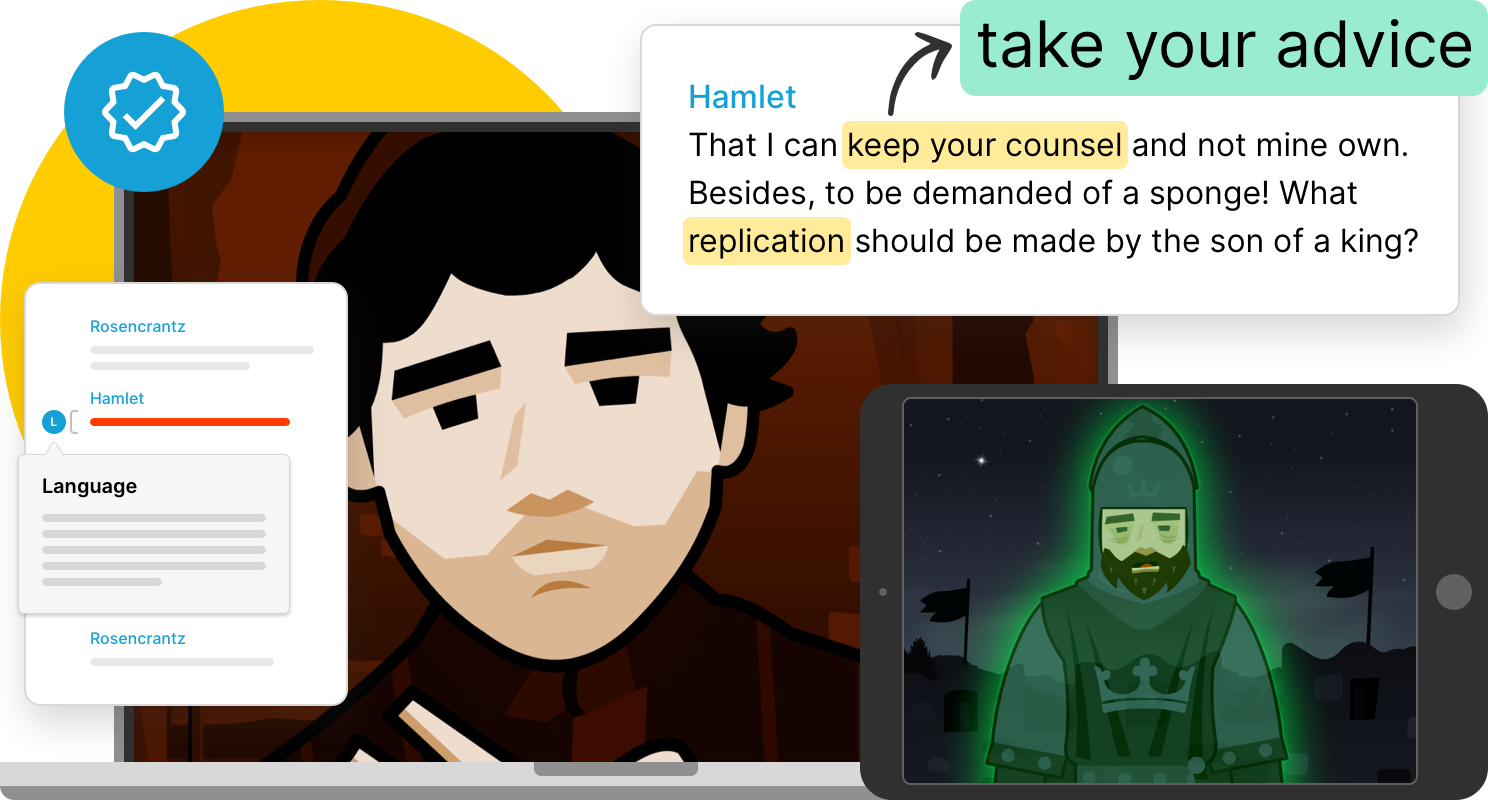
Shakespeare In Bits aims to address this potential disconnect
by blending technology and content to provide a more
stimulating, contemporary learning experience. Graphics,
audio, and text combine to provide users with multiple
cognitive inputs while on-demand rollover notes, clickable
in-line translations, character bios etc also provide a degree
of interactivity that keeps the student more fully engaged
with the text. Importantly, this approach also allows the
students to interact with challenging words or phrases in
their original context, without resorting to "dumbed down"
modern "translations".
Pedagogical Perspective
The combination of animation, audio, and text delivered by
each Shakespeare In Bits title also allows students to process
information in a way that best suits their learning style.
Multiple intelligence theorists such as Howard Gardner have
argued that traditional educational methods best suit learners
with a strong verbal or logical-mathematical intelligence.
With Shakespeare In Bits, learners with a strong visual,
auditory or kinesthetic intelligence are also catered to,
through the rich graphic, aural, and interactive elements of
the software.
Other influential thinkers, such as developmental psychologist
Lev Vygotsky, have argued that active participation and social
interaction can maximize learning outcomes in the classroom.
Cognizant of this, Shakespeare In Bits allows students and
teachers the flexibility to use the product on their own in a
self-paced environment, or in a more collaborative group
settings via a projector in the classroom.
Our school licensing also facilitates flipped classroom
approaches, with students welcome to access the resources from
home, if required by their school.